
Red Tape Is a Tax on Time

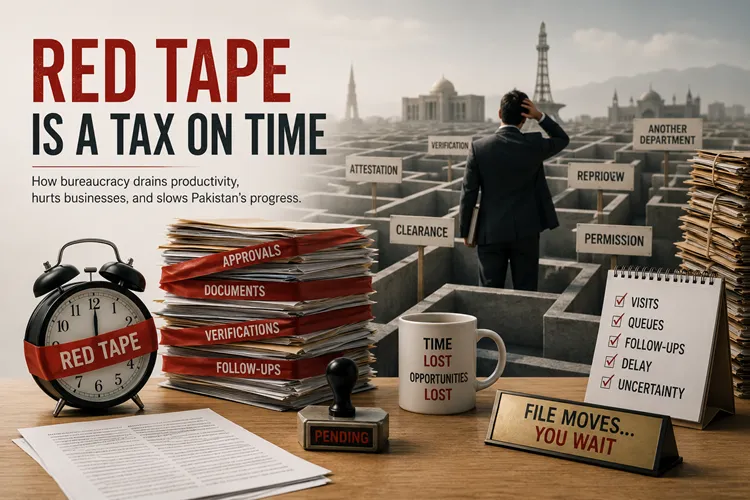
In Pakistan, red tape is not merely an inconvenience. It is a tax on time: a compulsory, unpriced burden paid by citizens and businesses through repeated visits, documents, attestations, queues, follow-ups, uncertainty and lost working hours. Unlike a conventional tax, it does not appear clearly on an invoice or in the federal budget. Yet its cost is real. It is paid by the shopkeeper who closes his business to visit a government office, the entrepreneur who delays hiring because a registration is incomplete, the exporter whose shipment waits for a clearance, and the ordinary citizen who must correct an error made by the state itself.
Pakistan’s governance challenge is therefore not only about policy quality or revenue collection. It is also about the everyday experience of dealing with the state. A government that consumes excessive time reduces national productivity, weakens trust and makes formal economic activity feel like punishment rather than progress.
The hidden cost of delay
Time is the one resource distributed equally among citizens, but red tape affects people unequally. A senior executive may delegate paperwork to a compliance officer, consultant or lawyer. A large corporation can maintain departments for taxation, company secretarial work, banking documentation and regulatory filings. A small manufacturer, trader, freelancer or first-time entrepreneur usually cannot.
For such people, each procedural requirement means time away from sales, production, customer service, family responsibilities and strategic work. A business owner may spend a day obtaining a document, another day correcting a spelling inconsistency, and a third day following up on a file that has moved from one desk to another. The formal fee may be small; the true economic cost is not.
This is why red tape behaves like a tax. It imposes a cost without necessarily improving the service received. It forces citizens to spend resources merely to establish that they are entitled to something: a company registration, tax correction, utility connection, bank account, import permission, land record, pension, licence or certificate.
The most damaging feature is uncertainty. A business can plan around a known tax rate. It can budget for a fixed registration fee. It cannot efficiently plan around an unknown number of visits, unpredictable interpretation of rules, a missing official, an unavailable portal, an unofficial demand for “facilitation,” or an objection raised after the applicant has already complied with previous instructions.
Governance by procedure, not outcomes
Pakistan has inherited a governance culture in which process often matters more than outcome. Officials are frequently trained to avoid personal risk, protect the file, document every movement and seek multiple approvals. The result is an administrative mindset in which saying “no,” asking for another document or referring the matter upward can feel safer than making a reasonable decision.
This is not simply a moral failure of individual public servants. It is also an institutional design problem. Many government officers operate in environments where they may be questioned later for approving a case, but rarely face consequences for delaying it. A decision can attract scrutiny; indecision often disappears into the system.
This creates a culture of defensive administration. Instead of asking, “How can this citizen’s legitimate request be resolved today?” the system may ask, “What document can protect this office from responsibility?” The citizen becomes a potential risk rather than the customer of a public service.
The consequences are visible in routine government interaction:
- Files move through layers of review even when the decision is simple.
- Offices demand photocopies of records that another government department already holds.
- Minor documentation differences can stop major transactions.
- A citizen is asked to prove the same identity, address, tax status or business existence repeatedly.
- An application may be rejected without clear, written guidance on how to correct it.
- An error made in a government database becomes the citizen’s burden to resolve.
A modern state should make compliance easy and evasion difficult. Too often, Pakistan makes both difficult: honest citizens struggle to comply, while those with connections, influence or access to intermediaries find ways around the system.
Company formation and the startup burden
Pakistan has made important progress in digitising company incorporation. The Securities and Exchange Commission of Pakistan provides electronic systems for name reservation, incorporation and certain corporate filings, and describes company registration as an end-to-end digitised process. Applicants still must supply key information and attachments, including constitutional documents and identity records of subscribers.secp+1
This is a positive development. Digital incorporation can reduce travel, improve traceability and limit discretionary contact with officials. However, incorporation is only the beginning of a business’s interaction with the state.
After a company is formed, an entrepreneur may have to navigate tax registration, sales tax issues where applicable, provincial labour registrations, social security, export documentation, local permits, sectoral licences, bank-account opening requirements and regular statutory filings. Each regulator may operate with its own format, definitions, portals, document standards and expectations.
The entrepreneur who wants to operate formally can therefore feel trapped in a maze. A simple mismatch in company name, address format, director information or tax profile may lead to rejection across multiple systems. Instead of data flowing automatically between SECP, FBR, banks and provincial agencies, the founder is often expected to become the integration layer between the institutions.
This is especially costly for startups. In the earliest stage, founders should spend time understanding customers, designing products, managing cash flow, recruiting talent and closing sales. When they instead spend weeks assembling documents and chasing approvals, the country loses innovation before it has had a chance to grow.
Pakistan rightly seeks entrepreneurship, exports, digitisation and investment. But those ambitions require an operating environment where forming and running a legitimate company is simpler than remaining informal. If the formal route is slow, opaque and expensive in time, many small businesses will choose informality—not because they reject the law, but because the law appears designed without regard for their reality.
Banking: necessary compliance, unnecessary friction
Banking is another arena where legitimate regulation can become excessive friction. Pakistan’s banks must comply with anti-money-laundering and counter-terrorist-financing requirements. These safeguards are important and cannot be dismissed. Banks are required to obtain and verify customer identity, details of the business, source of earnings, purpose of the account and expected transaction behaviour. For companies and partnerships, supporting records may include incorporation or registration evidence, tax information, constitutional documents, resolutions and identity documents of directors, partners or authorised signatories.sbp.org+1
The problem is not the existence of Know Your Customer requirements. The problem is poor coordination, inconsistent interpretation and the tendency to turn compliance into a ritual of document accumulation.
A legitimate business owner may already be registered with SECP, have an NTN, file returns, hold a valid CNIC and maintain a traceable digital footprint. Yet the same information may be demanded repeatedly, in different forms, through physical copies and multiple signatures. A bank branch may ask for an additional letter, stamp, verification or approval that another branch or another bank treats differently.
Even digital onboarding has expanded, including identity verification through NADRA-based mechanisms and biometric checks. But digitisation should not mean simply placing old paperwork on a screen. Its real purpose should be to eliminate duplicate data entry, permit secure verification between institutions and provide applicants with clear timelines and reasons for any rejection.sbp.org
For a small business, a delayed bank account can delay everything else: receiving customer payments, paying suppliers, processing salaries, accessing trade finance and building a credible financial history. When banking compliance becomes unpredictable, it becomes an obstacle to formalisation and financial inclusion.
Taxation and the punishment of correction
Tax administration is perhaps where the phrase “red tape is a tax on time” becomes most painfully accurate. Taxpayers do not object merely to paying tax. Businesses understand that public revenue is necessary for infrastructure, security, education, health and administration. What frustrates them is the amount of time required to comply, clarify, reconcile and correct.
A taxpayer may file in good faith yet encounter a system mismatch, an incorrect demand, a wrong classification, an unadjusted payment, a duplicate liability or an error originating from the department’s own records. At that point, the burden commonly shifts to the taxpayer. They must prepare applications, attach proof, visit offices, submit representations, track acknowledgements and repeatedly explain a matter that the government could verify electronically.
This reverses a basic principle of good administration. If the government commits an error, the government should correct it quickly, transparently and without making the citizen prove the same point over and over. There should be a defined service-level standard: for example, an acknowledged correction request, a named case officer, a digital status trail and a final decision within a stated number of working days.
Instead, rectification may become a separate project. The taxpayer spends money on accountants, tax advisers and transport, while also absorbing the anxiety of possible penalties, blocked refunds, notices or disrupted business operations. Large firms may manage this burden. Small businesses often cannot. They either remain outside the tax net, underreport activity or treat compliance as a recurring crisis.
That is counterproductive. A tax system earns compliance not only through enforcement but also through credibility. Citizens are more willing to comply when they believe the system is fair, predictable and capable of correcting its own mistakes.
Reforming the state’s relationship with time
Pakistan does not need to abandon rules. It needs better rules, better-designed procedures and a different administrative ethic. The aim should be a state that is firm against fraud but fast for the honest citizen.
Civil-service training must change accordingly. Officers should be trained not only in rules, noting and file procedure, but also in service design, decision-making, risk assessment, digital governance, communication and economic impact. A public servant should understand that every unnecessary document request has a cost, every unexplained delay harms trust, and every unresolved case may deprive a business of growth, employment and investment.
Several reforms would have an immediate effect:
- Adopt “once-only” data principles so citizens do not repeatedly submit information already held by government.
- Integrate SECP, FBR, NADRA, banks and relevant provincial departments through secure and lawful data verification.
- Publish clear checklists, fees, timelines and rejection reasons for every major public-facing service.
- Create automatic escalation when an application exceeds its statutory or published processing time.
- Make correction of government errors a priority service, with no additional burden on the affected citizen.
- Measure offices by resolution time and citizen outcomes, not merely by number of files processed.
- Reduce physical attestations, stamps and photocopies where digital verification is possible.
- Protect officials who make reasonable, documented decisions in good faith, so fear does not produce paralysis.
- Strengthen accountable grievance systems that resolve complaints rather than simply acknowledge them.
Pakistan’s citizens are resilient, inventive and accustomed to solving problems despite institutional friction. But national progress should not depend on extraordinary patience. Every hour wasted in a queue, every unnecessary visit, every duplicate form and every unresolved government error drains energy from national productive activity.
Red tape is a tax on time because it extracts value from people without creating value in return. Reducing it would not be a cosmetic administrative reform. It would be an economic reform, an anti-corruption reform, a competitiveness reform and, above all, a reform of the relationship between the Pakistani state and its citizens.
Imtiaz Rastgar is Ex CEO of the EDB, MOIP, 2004-7. His essays are general published at Medium.com.